

We're still rationing
There is a peculiarly British way to lose money: slowly, sensibly, and with the government's blessing.

Last year, British savers piled £69 billion into Cash ISAs, where the interest barely keeps up with inflation.
They put only £31 billion into investments.
Two million people opened a new Cash ISA.
Just under three hundred thousand opened a Stocks and Shares one.
Nearly ten to one, in favour of the option that pays less than rising prices.
There is currently somewhere north of four hundred billion pounds sitting in British Cash ISAs. Not invested. Just sitting. Earning less, in real terms, every year.
Four and a half million British adults have ten thousand pounds or more in a Cash ISA and no stock-market investments at all.
They are perfectly intelligent, rational people. They have chosen the option that loses them money slowly because the option that makes them money felt unsafe.
Why?
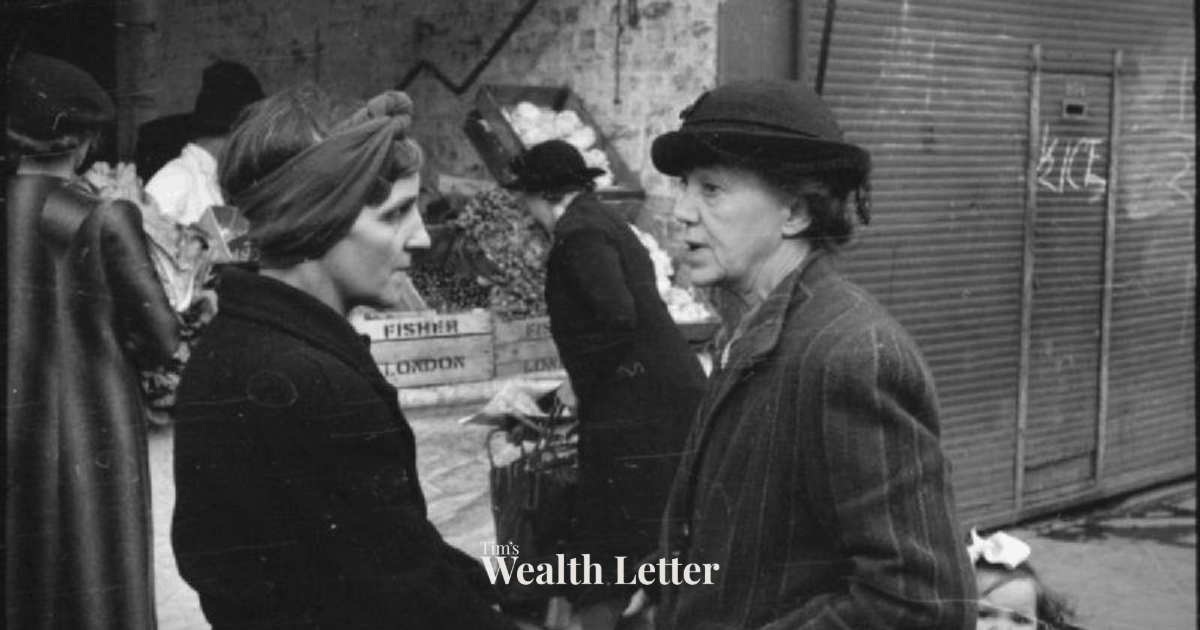
My bet — and I'm openly flagging this as a hunch, not a finding — is that we never quite got over the war.
People forget how long it took us to come out of it. Rationing didn't end in 1945. It ended in 1954, nine years after VE Day. Britain was the last country involved in the war to stop rationing food. Sweets came off the ration in 1953. Meat held on until the summer of 1954.
The generation that came out of that did not grow up thinking life was generous. They grew up being told that saving was virtuous and spending was suspect.
Make do. Mend. Don't be flash. Don't get ideas above your station.
They taught their children. Their children taught us.
Meanwhile, on the other side of the Atlantic, the same war ended in suburbs, the GI Bill, and a long, deliberate campaign to convince ordinary Americans they should own a piece of the country they'd fought for.
Two victors. Two completely different settlements. Eighty years on, we're still living in the shape of them.
The phrases give us away:
Saving for a rainy day. Neither a borrower nor a lender be.
If it sounds too good to be true, it probably is.
All of these sound like wisdom. None of them survives contact with a compound interest table.
Twenty thousand pounds in a Cash ISA at 3%, with inflation running at two and a half, grows to about twenty-two thousand pounds in real terms after twenty years.
The same twenty thousand in a global stock-market tracker, at the long-run average return of around 10% a year, grows to about eighty thousand.
The Cash ISA saver hasn't lost money in the sense their bank statement would recognise. The balance is still going up every year.
But they have lost about sixty thousand pounds in the only sense that matters — the things that money could have bought them, twenty years later.
That isn’t recklessness. That’s caution. The British kind: careful, sensible, slightly proud of itself, and quietly very expensive.
We thought we were being careful.
We were just being scared.
The two aren’t the same…
Long-run figures here are based on historical averages, not predictions. The value of investments can fall as well as rise, and the past is not a guide to the future. I am not a financial adviser — nothing here is personal financial advice. Please do your own research before making any decisions.
Love this!